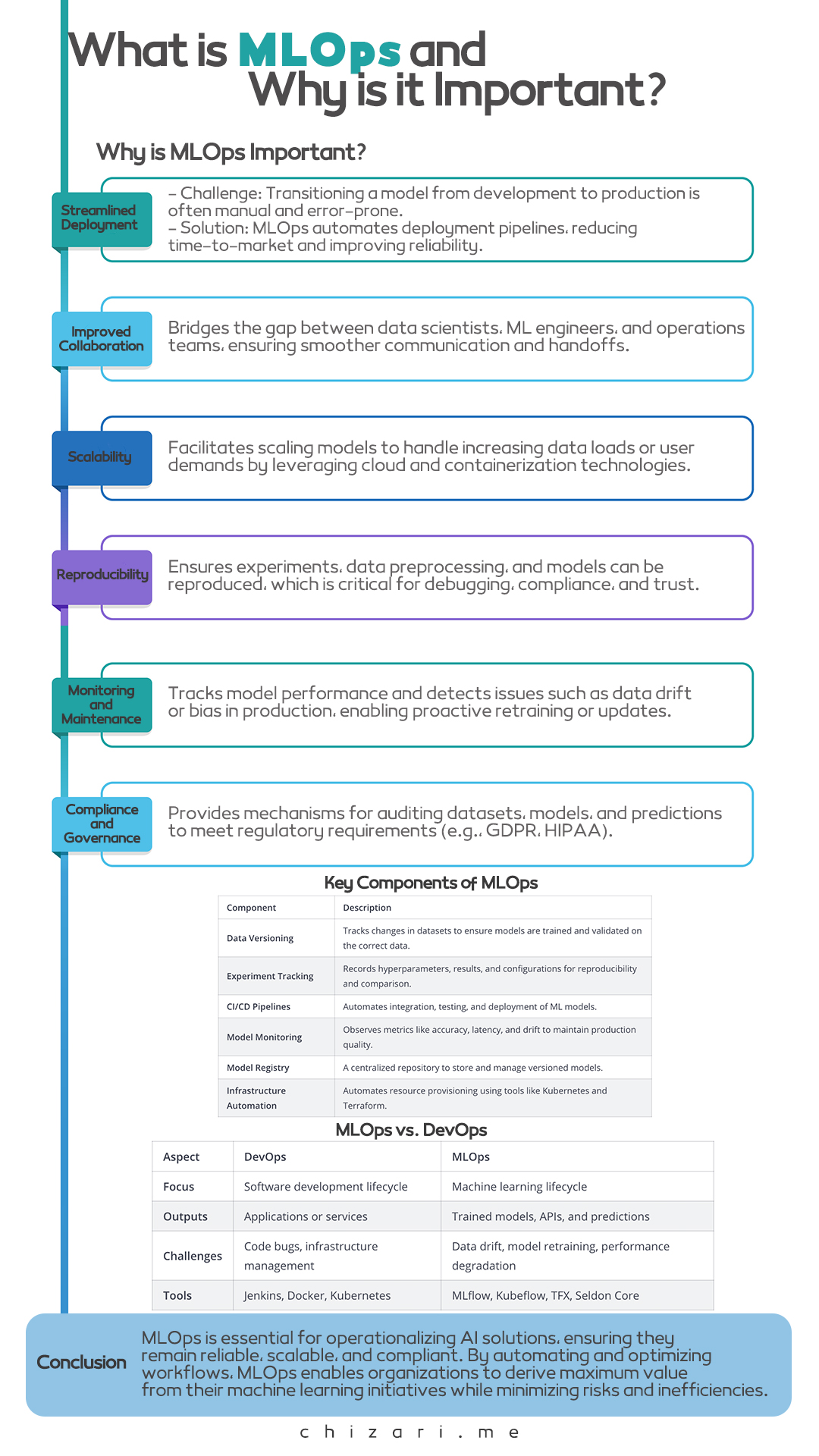
Text of this infographic
What is MLOps and why is it important?
Streamlined deployment: moving a model from development to production is often manual and error-prone; MLOps automates deployment pipelines, cutting time to market and improving reliability. Improved collaboration: it bridges data scientists, ML engineers and operations teams. Scalability: it helps models handle growing data and demand through cloud and container technology. Reproducibility: experiments, data preparation and models can be reproduced, which matters for debugging, compliance and trust. Monitoring and maintenance: it tracks model performance and detects data drift or bias in production, so models can be retrained in time. Compliance and governance: it gives ways to audit datasets, models and predictions against rules such as GDPR and HIPAA.
Key components: data versioning (tracks changes in datasets so models train and validate on the right data); experiment tracking (records hyperparameters, results and configurations); CI/CD pipelines (automate integration, testing and deployment of models); model monitoring (accuracy, latency and drift); a model registry (one place to store and manage versioned models); infrastructure automation (provisioning with tools such as Kubernetes and Terraform).
MLOps vs DevOps. Focus: the machine learning lifecycle, not the software lifecycle. Outputs: trained models, APIs and predictions, not applications or services. Challenges: data drift, retraining and performance decay, not code bugs and infrastructure. Tools: MLflow, Kubeflow, TFX and Seldon Core, not Jenkins, Docker and Kubernetes.
Conclusion. MLOps is essential for running AI in operation: it keeps solutions reliable, scalable and compliant, and by automating workflows it helps organizations get value from machine learning while reducing risk and waste.