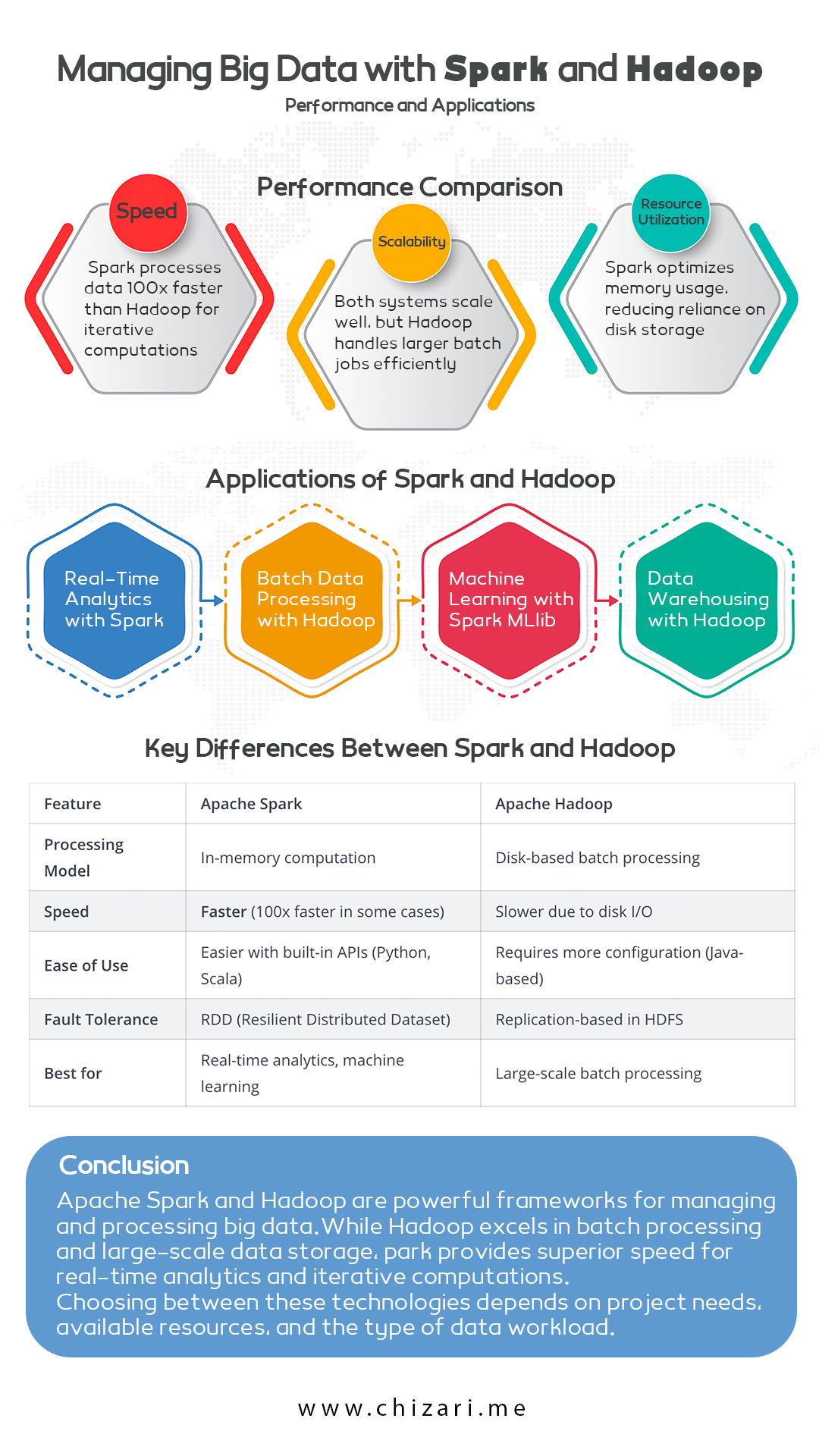
Text of this infographic
Managing big data with Spark and Hadoop: performance and applications.
Performance. Speed: Spark processes data up to 100 times faster than Hadoop for iterative computations. Scalability: both scale well, but Hadoop handles larger batch jobs efficiently. Resource use: Spark optimizes memory use, reducing reliance on disk storage.
Applications: real-time analytics with Spark, batch data processing with Hadoop, machine learning with Spark MLlib, data warehousing with Hadoop.
Key differences (Spark, then Hadoop). Processing model: in-memory computation; disk-based batch processing. Speed: faster (up to 100 times in some cases); slower because of disk input and output. Ease of use: built-in APIs in Python and Scala; more configuration, Java-based. Fault tolerance: resilient distributed datasets (RDD); replication in HDFS. Best for: real-time analytics and machine learning; large-scale batch processing.
Conclusion. Both are powerful frameworks for big data. Hadoop excels at batch processing and large-scale storage; Spark is faster for real-time analytics and iterative computation. The choice depends on the project, the resources and the type of workload.